
How AI Is Changing Jobs in 2026: Opportunities Risks and the Future of Work !
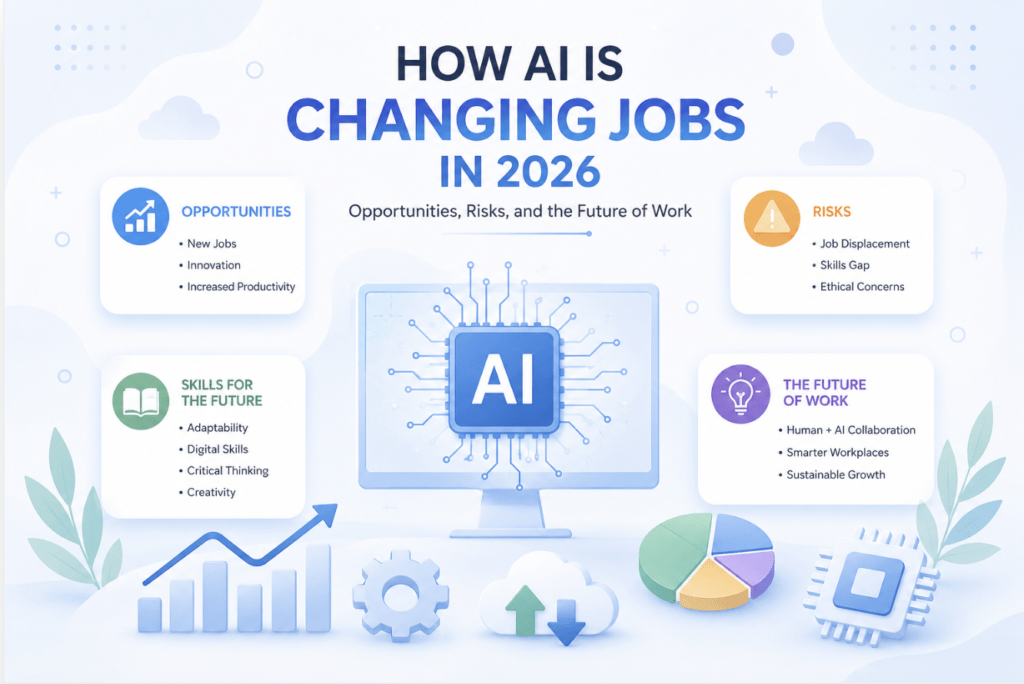
Artificial Intelligence (AI) is transforming the way people work across almost every industry. From customer service and healthcare to finance, education, and manufacturing, AI-powered tools are automating tasks, improving productivity, and changing job roles faster than ever before. While some people fear AI will replace human workers, others believe it will create new opportunities and improve the quality of work. The reality lies somewhere in between.
How AI Is Affecting Jobs
AI systems can perform repetitive and data-based tasks much faster than humans. Companies are now using AI for:
- Data analysis
- Customer support chatbots
- Resume screening and recruitment
- Content creation
- Image and video editing
- Coding assistance
- Fraud detection
- Medical diagnosis support
As a result, many traditional job roles are evolving. Employees are now expected to work alongside AI tools rather than compete against them.
Jobs Most Affected by AI
Some jobs that involve repetitive tasks are more vulnerable to automation. These include:
- Data entry operators
- Telecalling and basic customer support
- Bookkeeping and accounting support
- Basic graphic design tasks
- Manufacturing assembly line jobs
- Simple content writing
However, AI is not eliminating all jobs. Instead, it is reducing manual workload and increasing demand for skilled professionals who can manage, operate, and improve AI systems.
New Career Opportunities Created by AI
AI is also generating entirely new job categories. Some of the fastest-growing AI-related careers include:
- AI Engineer
- Machine Learning Specialist
- Prompt Engineer
- Data Scientist
- Cybersecurity Analyst
- AI Content Strategist
- Robotics Technician
- AI Product Manager
Companies worldwide are hiring professionals with AI skills, making this one of the most in-demand sectors in 2026.
Human Skills Still Matter
Even with advanced AI technology, human creativity and emotional intelligence remain essential. Skills that AI cannot easily replace include:
- Leadership
- Communication
- Critical thinking
- Creativity
- Problem-solving
- Emotional understanding
- Team management
Professionals who combine technical knowledge with human-centered skills will have better career opportunities in the future.
How Employees Can Prepare for the AI Era
To stay competitive, workers should focus on continuous learning and skill development. Some useful steps include:
- Learn AI tools related to your industry
- Improve digital and technical skills
- Take online certifications in AI and automation
- Develop communication and leadership abilities
- Stay updated with industry trends
Adapting to technology instead of resisting it can help professionals grow in the changing job market.
Share Box
Conclusion
AI is not just replacing jobs — it is reshaping the future of work. While automation may reduce some traditional roles, it is also creating new career opportunities and improving efficiency across industries. The key to success in the AI-driven world is adaptability, learning, and developing skills that complement technology. Workers who embrace AI and continue upgrading their abilities will be better prepared for the future job market.